





When I first learned research design in research methodology, I realized one thing fast: a weak design can ruin a strong topic. You may have a smart research question, but without a clear blueprint, your data can become scattered, biased, or impossible to interpret.
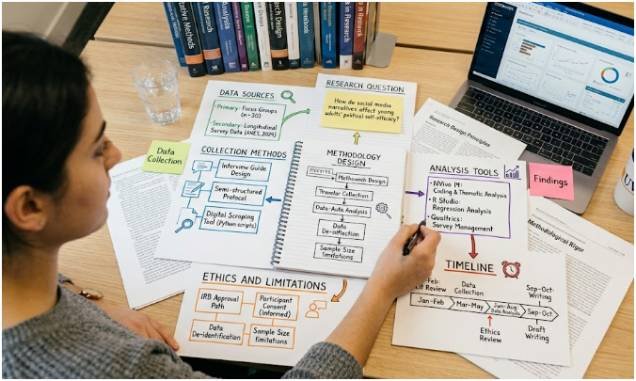
Research design is the framework that guides an entire study. It explains what data you need, where you will get it, how you will collect it, and how you will analyze it. Research methods are the actual procedures used for collecting and analyzing data, while research design connects those methods to the research question.
What Is Research Design in Research Methodology?
Research design is the conceptual plan for a study. I like to think of it as the bridge between a research question and credible findings. It tells readers that your study is not based on guesswork.
A strong design answers four basic questions. Who or what will you study? How will you collect the data? How will you analyze it? How will the results answer the research question?
That is why research design in research methodology matters so much in thesis writing, dissertations, research papers, and academic proposals. It gives your study direction before you start collecting data.
Why Research Design Matters Before You Collect Data
I have seen students pick surveys, interviews, or case studies before they fully understand their research problem. That usually creates problems later.
For example, if your question asks, “How do first-generation college students experience academic pressure?” a survey alone may not capture the depth of personal experience. A qualitative design may fit better.
But if your question asks, “What percentage of first-generation students report high academic stress?” a quantitative survey may work better.
Good research design improves validity, reliability, neutrality, and generalizability. In simple terms, it helps your study measure what it claims to measure, produce consistent results, reduce bias, and apply findings beyond the sample when appropriate.
Key Components of a Strong Research Design

A good design does not need to sound complicated. It needs to be clear, logical, and aligned with the research question.
Data Sources
Data sources are the people, records, documents, databases, or settings you study. In academic research, these may include students, teachers, patients, employees, public records, published datasets, or interview participants.
Your data source should match your question. If your study explores student writing struggles, your sample should include students who have direct experience with academic writing.
Data Collection Methods
Collection methods are the tools you use to gather information. Common options include surveys, interviews, experiments, observations, focus groups, archival research, and document analysis.
The method must fit the evidence you need. Surveys work well for patterns across a larger group. Interviews work better for personal meaning, lived experience, and detailed explanations.
Analysis Tools
Analysis tools explain how you will interpret the data. Quantitative studies may use descriptive statistics, t-tests, ANOVA, regression, or correlation analysis. Qualitative studies may use coding, thematic analysis, narrative analysis, or content analysis.
Software can support this process. Quantitative researchers often use tools like SPSS, R, Stata, or Excel. Qualitative researchers may use NVivo, ATLAS.ti, Dedoose, or manual coding.
Timeline and Sequence
Timeline matters because some designs happen in stages. A simple survey may collect all data at once. A mixed-methods project may collect survey data first, then follow up with interviews.
This sequence affects your analysis. If the order is unclear, your results may feel disconnected.
Main Types of Research Design

The three major categories are quantitative, qualitative, and mixed methods. Each one answers a different kind of research question.
Quantitative Research Design
Quantitative design uses numerical data. It is useful when you want to measure variables, test relationships, compare groups, or examine cause and effect.
Descriptive design observes and describes a population or variable. Experimental design tests cause-and-effect by manipulating an independent variable. Quasi-experimental design studies causal links without random assignment. Correlational design examines relationships between variables, but it does not prove causation.
For example, if I wanted to study whether weekly writing workshops improve thesis completion rates, I might use a quasi-experimental design if random assignment is not possible.
Qualitative Research Design
Qualitative design uses non-numerical data, such as interviews, observations, field notes, or documents. It helps researchers understand meaning, behavior, experience, and social context.
Phenomenological design explores lived experiences. Grounded theory builds theory from collected data. Ethnographic design studies a culture or community. Historical design analyzes past events, records, and artifacts.
A qualitative design fits well when your research question starts with “how” or “why.” It also works when the topic needs depth instead of large-scale measurement.
Mixed-Methods Research Design
Mixed methods combine quantitative and qualitative approaches in one study. This design is useful when numbers alone do not explain the full story, and interviews alone cannot show the broader pattern.
Harvard Catalyst describes mixed methods as a way to combine rigorous quantitative and qualitative methods so researchers can draw on the strengths of each approach.
Mixed-methods designs often include convergent parallel, explanatory sequential, and exploratory sequential structures. These designs differ by timing, order, and the point where the two data strands connect.
How Mixed-Methods Data Analysis Works
Mixed-methods analysis depends on integration. You do not simply place numbers and interview quotes in the same paper. You connect them in a purposeful way.
Analyze Each Data Strand Separately First
Before mixing data, analyze each strand using its own method.
For quantitative analysis, clean the numerical data and run the right statistics. That may include averages, percentages, t-tests, ANOVA, regression, or correlation.
For qualitative analysis, transcribe interviews, code the text, and group codes into themes. This step helps you identify patterns in participant language and experience.
Integrate the Findings With the Right Strategy
In a convergent parallel design, you collect and analyze quantitative and qualitative data at the same time. Then you compare findings side by side.
In an explanatory sequential design, you analyze quantitative data first. Then you use qualitative data to explain surprising trends, outliers, or unclear results.
In an exploratory sequential design, you begin with qualitative research. Then you use the themes to build a survey or measurement tool for a larger sample.
Use Joint Displays for Clearer Interpretation
Joint displays are tables, matrices, or visuals that place quantitative findings beside qualitative themes. They help researchers identify agreement, contradiction, or expansion across datasets. Research on mixed-methods integration highlights joint displays as a useful tool for planning, implementing, and representing integrated findings.
For example, your survey may show that 72% of students feel confident using citation tools. But interviews may reveal that many still fear accidental plagiarism. That contradiction is not a failure. It is a finding.
My Practical Design Fit Test for Students
When I help plan a study, I use a simple four-question test before choosing the design.
First, ask what the research question really wants. If it asks “how many,” “how much,” or “what relationship,” quantitative design may fit. If it asks “how,” “why,” or “what is the experience,” qualitative design may fit.
Second, check the data type. Numbers need statistical analysis. Stories, documents, and experiences need thematic or interpretive analysis.
Third, check whether one method is enough. If the numbers show a trend but cannot explain it, mixed methods may be stronger.
Fourth, check your resources. A complex mixed-methods study needs more time, more planning, and stronger organization than a basic descriptive design.
This is also where an internal methodology resource can help. For a fuller writing structure, use How to Write Research Methodology as your next supporting guide.
Common Mistakes to Avoid When Choosing a Research Design
The biggest mistake is choosing a method because it feels easy. A survey may look simple, but it can produce weak results if the questions are poorly written.
Another mistake is confusing correlation with causation. If two variables move together, that does not prove one caused the other.
Students also forget to explain why they chose a design. A thesis committee wants to see the logic behind your choice. Do not just say, “This study uses qualitative methods.” Explain why qualitative methods best answer the research question.
A final mistake is treating mixed methods as “more impressive” by default. Mixed methods only work when integration adds value. If you cannot explain how the two strands connect, the design may become messy.
FAQs About Research Design in Research Methodology
1. What is the meaning of research design in research methodology?
Research design means the overall blueprint of a study. It explains the data sources, collection methods, analysis tools, and timeline used to answer the research question.
2. What are the main types of research design?
The main types are quantitative, qualitative, and mixed-methods designs. Quantitative designs use numerical data, qualitative designs use non-numerical data, and mixed methods combine both.
3. Why is research design important in a thesis?
Research design is important because it proves that your study is planned, logical, and credible. It also helps your advisor or committee understand how your evidence supports your argument.
The Final Word: Don’t Let Your Study Wander Around Unsupervised
I see research design as the part of a study that keeps everything under control. It tells your data where to go, tells your methods what to do, and tells your reader why your findings deserve trust.
A strong design does not make research harder. It makes the work cleaner. Before you collect one survey response or schedule one interview, check that your question, data, method, analysis, and timeline all point in the same direction. That one step can save weeks of rewriting later.