




The internet makes research feel easier until you actually start collecting sources. One search can pull up thousands of articles, blogs, opinion pieces, PDFs, and “expert” claims within seconds. At some point, almost every student or researcher realizes that finding information is not the hard part anymore. Figuring out what deserves trust is.
I learned this the frustrating way during a long research assignment where I confidently used a source that looked professional but turned out to be outdated and heavily biased. Since then, evaluating source credibility became part of my research habit instead of something I rushed through at the end. Strong research papers are rarely built on random links. They are built on careful source evaluation and consistent fact-checking.
Why Source Credibility Matters More Than Ever

Research quality depends heavily on the strength of your references. Even a well-written argument can lose credibility if the supporting sources are weak, inaccurate, or misleading.
This problem has become more common because misinformation spreads quickly online. AI-generated articles, low-quality blogs, manipulated statistics, and opinion-heavy websites can easily appear alongside legitimate scholarly articles in search results. That makes source credibility a critical part of academic integrity.
Professors, editors, and reviewers often judge research quality by looking at:
- The reliability of references
- Citation quality
- Use of peer-reviewed journals
- Balance and objectivity in arguments
A credible source does more than provide information. It strengthens trust in your work.
Understanding The CRAAP Test
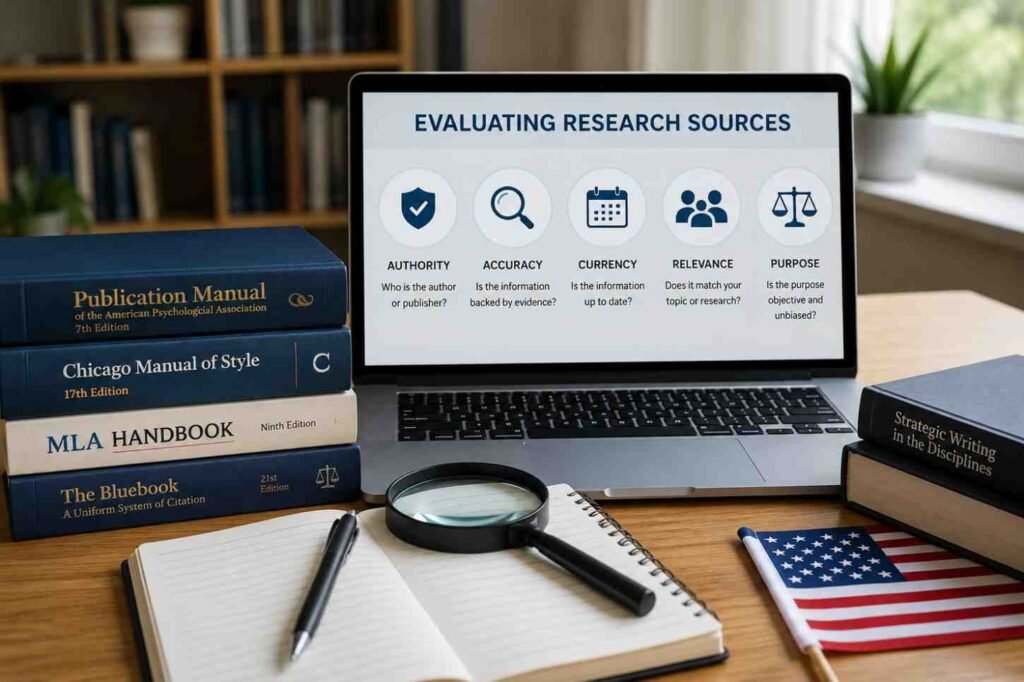
One of the most practical methods for research source evaluation is the CRAAP Test. Many universities and academic libraries still recommend it because it simplifies credibility checks into clear categories.
Currency
Always check when the source was published or last updated.
Some topics stay relevant for years, while others change rapidly. Medical studies, technology trends, digital marketing statistics, and public policy research can become outdated very quickly.
If you are researching social media behavior from 2015 or cybersecurity data from several years ago, the information may no longer reflect current realities.
Pay attention to:
- Publication date
- Updated versions
- Broken links
- Older statistics
Fresh information usually improves research accuracy.
Relevance
A source may be credible but still irrelevant to your topic.
This is something many students overlook while gathering material quickly. A highly respected journal article does not automatically belong in your paper if it only partially addresses your research question.
Look for:
- Direct alignment with your argument
- Appropriate audience level
- Specific evidence related to your topic
- Useful supporting examples
This becomes even more important when using effective research paper planning strategies because strong planning helps you avoid collecting unnecessary references early on.
Authority
Always identify who created the content.
Author credentials matter because expertise affects reliability. A professor specializing in climate science carries more authority on environmental policy than a random anonymous blogger.
Good signs include:
- Academic degrees
- Institutional affiliations
- Published research history
- Professional expertise
- Recognized industry experience
Reliable research sources usually make author information easy to verify.
Accuracy
Credible academic sources rely on evidence instead of assumptions.
A trustworthy source should include:
- Supporting studies
- Data references
- Citations
- Research methodology
- Verifiable claims
If statistics appear without explanation or evidence, treat the source carefully. Cross-checking information with academic databases or scholarly articles also helps confirm accuracy.
Purpose
Every source has a purpose behind it.
Some aim to educate. Others aim to persuade, promote, or provoke emotional reactions. Understanding intent helps you identify biased information before using it in your work.
Be cautious with sources that:
- Push extreme viewpoints
- Use emotional language
- Promote products aggressively
- Ignore opposing evidence
- Present opinions as facts
Balanced writing generally signals stronger scholarly credibility.
Visual Signs That Help Identify Trustworthy Information

Sometimes you can spot weak sources before even reading deeply into the content.
Domain Extensions Matter
Educational and government websites often provide more reliable references than random commercial websites.
Commonly trusted domains include:
- .edu
- .gov
- .org
That does not mean every .com website is unreliable, but commercial platforms sometimes prioritize traffic over evidence-based information.
Peer Review Status
Peer-reviewed journals remain one of the strongest indicators of research credibility.
In a blind peer-review process, experts evaluate the study before publication. This helps filter weak research, unsupported claims, and flawed methodology.
Academic databases like:
- JSTOR
- PubMed
- Google Scholar
- Scopus
can help you locate scholarly articles with stronger academic value.
Citation Count
Citation count often reveals how influential or respected a study is within the academic community.
If many researchers reference the same study, it usually suggests the work contributed meaningful information to the field.
However, citation count should support evaluation, not replace it entirely.
Publisher Reputation
The publisher behind a source matters more than many people realize.
University presses, recognized scientific journals, and established academic publishers generally maintain stricter editorial standards. Random websites with unclear ownership often do not.
Common Warning Signs Of Poor Sources

Weak sources usually reveal themselves through patterns.
Missing Information
Be careful when sources are lacking:
- Author names
- Publication dates
- Citations
- Reference lists
- Contact details
Transparency matters in credible research writing.
Biased Or Emotional Language
Reliable references typically maintain professional and balanced language. If a source sounds overly aggressive, political, dramatic, or emotionally manipulative, credibility becomes questionable.
Watch for phrases like:
- “The shocking truth”
- “What they do not want you to know.”
- “Guaranteed proof”
Sensational wording often signals weak evidence.
Poor Website Quality
A messy website does not automatically mean false information, but poor editing can reflect low standards.
Warning signs include:
- Frequent spelling errors
- Broken pages
- Excessive advertisements
- Clickbait headlines
- Outdated designs
A professional presentation alone is not proof of quality, but careless formatting can raise concerns.
Conspiracy-Based Claims
Extraordinary claims require strong evidence.
If a source completely rejects established research consensus while offering little verifiable support, approach it critically. Reliable research encourages skepticism, but it also depends on evidence and fact-checking.
FAQs: How To Evaluate Credible Research Sources Before Citing Them
1. How can I tell if a research source is credible?
Check the author credentials, publication date, evidence provided, citations, publisher reputation, and peer-review status. Reliable sources usually present balanced and verifiable information.
2. Are peer-reviewed journals always trustworthy?
Peer-reviewed journals are generally more reliable because experts evaluate the research before publication. However, researchers should still examine methodology, relevance, and potential bias.
3. Why is the publication date important in research?
Some subjects change rapidly over time. Older studies may contain outdated statistics, expired information, or conclusions that newer research has challenged.
4. Can websites with .com domains still be credible?
Yes. Many respected news organizations, research companies, and professional publications use .com domains. The domain alone should not determine credibility.
Final Thoughts
Learning how to evaluate credible research sources before citing them can completely change the quality of your work. It helps you build stronger arguments, avoid misinformation, and write with more confidence. Good research is not about collecting the highest number of references. It is about selecting reliable references that genuinely support your ideas. Once you develop the habit of checking authority, relevance, accuracy, and purpose, research starts feeling far more intentional and organized.
Most weak papers fail long before the writing stage. They fail during source selection. Strong research begins with strong evidence.