CHAPTER III
Research Methodology
Quasi-Qualitative Research
The methods evolved during the initial research following the evaluation of literature and new learning concept in quasi-qualitative research and secondary analysis methods. The literature collected enlightened the researcher’s understanding of practical and effective methods for researching educational phenomena in a technical life. New concepts in quasi-qualitative and interpretative approaches enabled the researcher’s adaptation of appropriate methods for the unique focus of this study.
The problems addressed by this study have been pointed to by research and thinking in system design bricolage, diffusion theory and secondary analysis anchored in grounded theory, with the appendices providing the background summary of said methods mentioned, to arrive at the design aspect of the subject matter which is food dehydration craft technology.
This summary of the combined research methods to acquire data inductively, evaluate it in context and to generate the approaches deem to fit the conceptual framework of the study.
The study drew a combination of approaches: heuristic-technoscience with use of bricolage, diffusion theory and secondary analysis under grounded theory precepts.
Description of Methodology
Prior to conducting a research design, an initial theoretical model was developed using heuristics from prior research and technical experience. The initial model integrated the ideas and constructions generated during the first phase. The initial research activity reviewed the literature and developed researched questions. The literature review spanned the body of journals, abstracts, relevant book sections and references from articles concerning Philippines’ secondary school education in comparison to its Asian neighbors and across the works of food dehydration process, and industrial design disciplines.
Methodology review was conducted across the qualitative and quantitative research literature starting from phenomenology and hermeneutics-evaluative studies (Gadamer,1976; Maanen,1991; Patton,1990, Straus and Corbin,1990; Denzin and Lincoln,1994). The methods of grounded theory, Actor network theory and diffusion theory were investigated and documented. As a consequence, the combination of qualitative and quantitative methods or mix-blend, a methodological eclecticism is perhaps more acceptable than methodological purism. According to Paille’ (1996), quasi-qualitative methods can be distinguished from qualitative methods in that the latter aim to reconstruct and comprehend lived experience (meaning) stored in a certain way in texts whereas the former methods concentrate on the form of the material to be analyzed and strive for some kind of measurement. It is during the structuralists effervescence of the 1960s in France’s sociological context that numerous quasi-qualitative approaches were developed for adoption into different strands of research. The following lists few of the examples:
- Niklas Luhman’s systems theory in the cognitive sciences, cultural and media studies influenced by North American post-structuralism; Baudrillard’s hyper-structuralist simulacra theory, Levi-Strauss’ mathematical equations (1958,p.282) and Pêcheux’s algorithms (1969).
- Glaser and Strauss (1967,pp.103-105) in their now famous introduction to constant comparative analysis briefly describes analytic induction that involves generating theory that emphasizes the generating function approach without testing thus the term grounded theory. The theory produced by analytic induction is universal, precise and limited that’s why Glaser and Strauss’ approach involves constant comparison with properties as processes, types, consequences, dimensions and conditions.
- The bricolage approach was termed by Claude Levi-Strauss for the pieced-together practices that provide solutions to the problem in a concrete situation. Bricolage employs the methods and theories of various disciplines when needed to understand the material in question providing a meta-analysis of the project.
This method was used in the computer simulation modeling of the proposed design of the food dehydrator and is also current in the computer modeling research method.
Research Design Rationale
The heuristic-technoscience approach in the secondary analysis method includes the following processes: initial engagement (in the study of food dehydration), immersion in the technological processes; incubation, and illumination to the different food dehydration methods; explication and creative synthesis to arrive at a proposed design.
Secondary data were used in the analysis to inform, confirm and constrain the mathematical interpretation and subsequently the design of the food dehydrator and the accompanying process steps in dehydration.
An overview of the diffusion theory and its application in this dissertation provides a framework for examining how diffusion theory can be applied to the adoption of food dehydration craft technology. Disciplines ranging from agriculture to management which includes education to marketing have used diffusion theory to increase the adoption of innovative ideas, methods and products. Everett M. Rogers (1995), the best known scholar in the area of diffusion research who wrote the book Diffusion of Innovations (4th Ed,2003), is the most often cited work dealing with diffusion. As Rogers (2003) points out, diffusion is not the single encompassing theory but several theoretical perspectives, a meta-theory related to the overall concept of diffusion. Rogers (1997) defines diffusion as the process by which innovations are introduced and communicated through certain channels over time among members of a social system.
Rogers’ definition contains four elements that are present in the diffusion of innovation process. The four main elements are:
- Innovation – an idea, practices, or objects that is perceived as knew by an individual or other unit of adoption.
- Communication channels – the means by which messages get from one individual to another.
- Time – the three time factors are:
(a) innovation-decision process
(b) relative time with which an innovation is adopted by an individual or group.
(c) innovation’s rate of adoption.
- Social system – a set of interrelated units that are engaged in joint problem solving to accomplish a common goal and the education field is one social system.
An innovation is an idea, practice or object that is perceived to be new by an individual and communication is a process in which participants create and share information with one another to reach a common goal (Rogers,2003). This diffusion research focuses on five elements as shown by the conceptual model: a) the characteristics of an innovation as a new learning concept; b) the teachers or learners that consider adopting the concept; c) the characteristics of the individuals that may likely adopt an innovative method or process who are the teachers and other learners, they who are open to new ways of delivering knowledge; d) the consequences for a social sector that is added knowledge and new practice paradigm in education; and e) communication channels used to process the information to flow through networks – through the teachers and other learners.
In diffusion theory terms, teachers as potential adopters are influenced in several ways. Firstly, the assumed shared values of teachers as being caring educators, wanting the best for his/her students and secondly, implicitly to improve their teaching approach and infuse innovative methods in learning concepts.
Hence much of research literature concerned with change and innovation in education and other related fields has been strongly informed and influenced by the tenets of diffusion theory. Typically applied to the study of technology based change, diffusion theory is consistent with many of the commonly used frameworks that account for change in education.
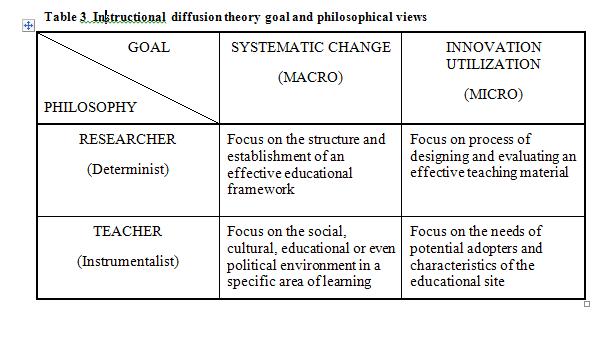
The instructional philosophy and goal in diffusion theory as applied to education is similar to those applied in the management of an organization with the end view of change or introduction of a better product or system personified by the teachers and their students as envisioned by the education establishment.
Cause and Effect Analysis in Philippine Education
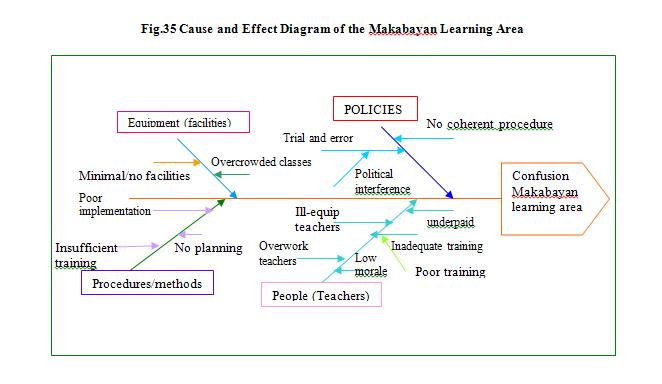
The present research applies the root cause analysis to the problem besetting the Makabayan learning area which is a reflection of today’s Philippine education and uses the Ishikawa diagram or fishbone diagram due to its appearance after its originator, Kaoru Ishikawa. The “Effect” is a desirable or undesirable situation produced by a system of causes which becomes the ISSUE. The causes are grouped into four basic categories which, in the field of education, constitute the equipment, policies, procedures and the people. The fish bone diagram basically explains the causes of the problem that the Makabayan subject was and will continually confront until there is a clear delineation of what the learning area wants to impart to its learners, the students and their teachers.
 prepared and submitted by MARY ROSE FLORENCE S. COBAR
 January 22, 2001
 Acknowledgement
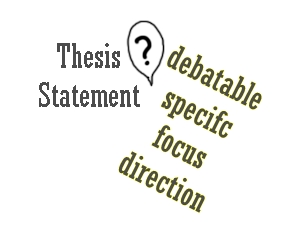 Thesis statement is written to expresses the main idea of your paper. You should make your reader agree with your opinion and to do this, you should provide evidences to prove your opinion. This sentence may call it a thesis statement. A thesis statement is writ
 It is very difficult for the student and professional to start writing a thesis because they do not know how to formulate a thesis statement. A good thesis should states the purpose on the document and should have a perfect structure. A weak thesis lacks in direction and uninteresting to the reader. A good thesis should have arguable claim and should be clear and specific as possible. It should also not answerable by yes or not but a fact that provides evidence. A thesis argument should prove with evidences from primary and secondary resources. These resources include articles, books, letters, diaries, government diaries, magazines, newspaper, etc.